Wondering if buying a lot in Kitty Hawk is as simple as finding the right piece of land and starting your house plans? In this part of the Outer Banks, it usually is not. Before you close, you need to know what can actually be built, what approvals may be required, and whether flood, septic, access, and zoning rules leave you with a workable homesite. Let’s dive in.
Why Kitty Hawk lot buying is different
Buying land in Kitty Hawk is different from buying land inland because you are purchasing on a barrier island with real environmental and development limits. According to the Town of Kitty Hawk, elevations range from 4 to 38 feet above mean sea level, most of the town’s 8.8 square miles are inside a Special Flood Hazard Area, and only about 15 percent of the land is outside the floodplain. The town also identifies hurricanes, Nor’easters, flooding, and coastal erosion as major hazards, which makes early due diligence essential. You can review the town’s flood information resources for more context.
That local reality affects how you should evaluate every lot. In Kitty Hawk, the question is rarely just how big the parcel is. The bigger question is whether the lot has a practical buildable envelope once flood rules, setbacks, septic needs, access, and zoning are all layered together.
Start with zoning first
Before you make an offer, confirm the zoning district and what uses are allowed on that parcel. Kitty Hawk’s zoning map divides land into beach zones, village zones, and Kitty Hawk Woods, with residential and commercial districts that allow different levels of intensity. The town’s zoning map and planning information are a strong first stop for understanding the basics.
If you have questions about a specific lot, Kitty Hawk’s Planning Director is the local contact for parcel-level zoning questions. The town’s Planning & Inspections Department can also advise on residential projects before you commit to a property. That step can save you time and money if your intended use does not fit the zoning as-is.
If you are considering a home on a parcel in a commercial zoning district, there may be another layer. Kitty Hawk’s residential building guide says a conditional use permit and application are required for residential construction in a commercial zoning district. That is the kind of issue you want to identify before due diligence ends, not after.
Check the lot design limits
Even if the zoning works, the lot still needs to support the home you want to build. Kitty Hawk’s residential building guide states that lot coverage may not exceed 30 percent, and that calculation includes more than just the house. It can include accessory structures, gravel, decks, driveways, walkways, pools, stairs, landings, and similar site improvements.
A 2025 ordinance also clarifies that the maximum allowable lot coverage by principal and accessory structures is 30 percent, with up to 38 percent physical area allowed when the excess is permeable pavement. That means site planning matters from day one. If you want generous outdoor living areas, parking, a pool, or wider hardscape areas, you need to know how those choices affect the lot’s limits.
The same guide notes that front setbacks are generally 25 feet, side and rear setbacks vary by house size, and maximum building height is 35 feet. It also states that structures in required setbacks are limited to 30 inches above finished grade and no living space is allowed in setbacks. In short, a lot may look large enough online, but still have a smaller usable footprint than you expect.
Understand septic and water early
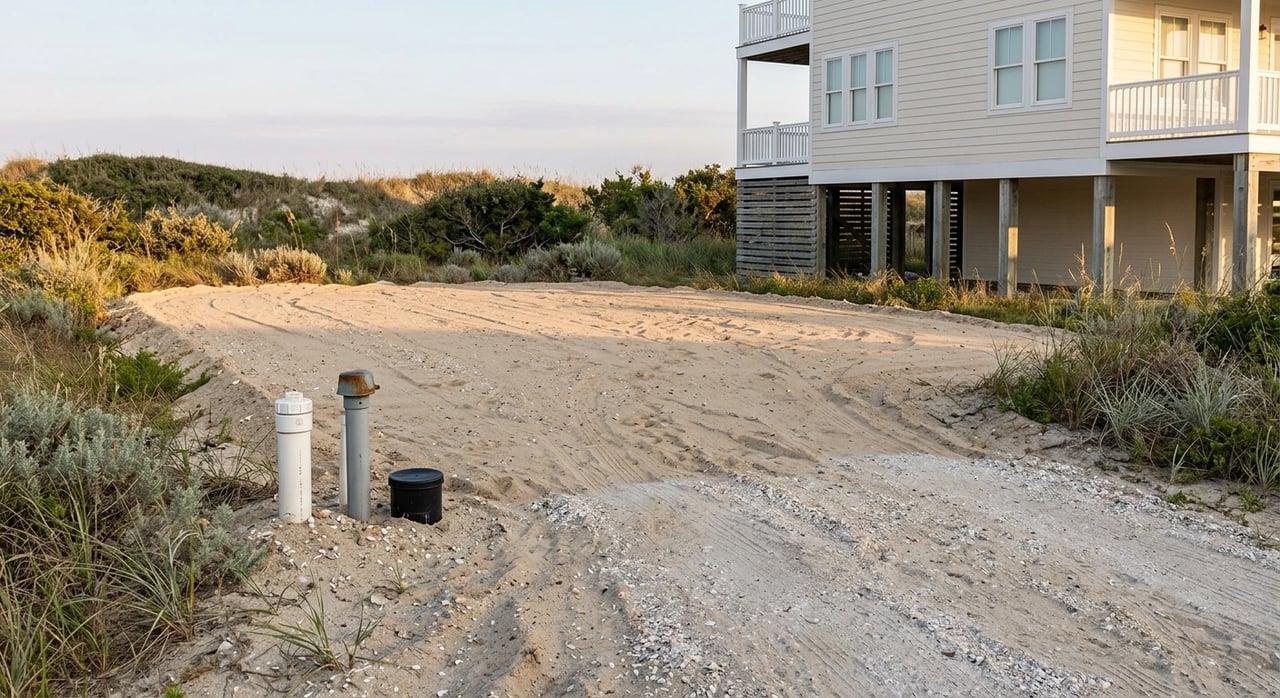
Utilities can make or break a Kitty Hawk lot purchase. The town’s land-use plan says there is no public sewer system in Kitty Hawk and none is planned, so nearly all homes and businesses rely on septic tank and drainfield systems. The same plan notes that soils are often not well suited to septic because of the shallow water table, while water service is provided through the Dare County Water Department.
That is why water and septic should be checked early in your due diligence period. Kitty Hawk’s residential permit packet says a water tap is required by the Dare County Health Department before a septic permit will be issued, and Dare County Environmental Health handles wastewater authorization. You can review those requirements in the town’s residential building permit packet.
If you wait until your house plans are complete to ask septic questions, you may find out too late that your preferred layout does not fit the site. In Kitty Hawk, utility feasibility is part of deciding whether a lot is truly buildable.
Review flood and elevation requirements
Flood risk is not a side note in Kitty Hawk. It is a core part of the buying decision and the future building process. The town’s flood page points buyers to flood-risk tools and elevation-certificate files, which can help you understand known conditions tied to a parcel.
FEMA says elevation certificates must be prepared by a licensed land surveyor, registered professional engineer, or architect authorized by law. Kitty Hawk’s building guide adds that an elevation certificate is required before rough inspection and again before a certificate of occupancy is issued. That means you should expect flood documentation and elevation work to be part of your overall project timeline and budget.
Ask about CAMA and environmental permits
Some lots need more than zoning and building permits. Kitty Hawk’s CAMA permit information explains that many land-disturbing activities in designated Areas of Environmental Concern require a Coastal Area Management Act permit. This can apply to oceanfront, estuarine shoreline, and soundside areas.
The town can issue Minor CAMA permits through its Local Permit Officer, which is helpful for buyers planning a build. The residential building guide also says that if a structure is adjacent to a navigable waterway such as a ditch or canal, CAMA approval is needed before building. If wetlands fill is involved, proper Army Corps of Engineers approval is also required.
Land disturbance rules matter too. The guide says undeveloped lots and disturbances under 5,500 square feet need a land disturbance permit, while 5,500 square feet or more requires an erosion and sedimentation control plan. For buyers, this means the lot’s location and site conditions can directly affect cost, timing, and approvals.
Confirm road access and site logistics
Access is another issue that can surprise lot buyers. Kitty Hawk’s residential guide says that if new construction is on an unimproved town right-of-way, the owner must obtain a municipal waiver and acknowledge that services may be restricted or unavailable. That is a big detail if you are buying a lot that appears accessible on a map but lacks the same practical access as neighboring homes.
The guide also says roadside swales may not be filled, and a driveway crossing a swale needs a culvert at least 15 inches in diameter. Dare County’s community map notes that private or HOA roads are not maintained by the state, county, or town. These details matter because access affects construction planning, long-term maintenance, and the overall use of the property.
Use county records, but verify everything
Dare County offers useful online tools for researching a lot. The county’s GIS and tax portal allows you to search by owner name, address, subdivision, PIN, or aerial map and review parcel data, tax bills, land transfers, photos, and deed information. Dare County also provides deed-history access for documents recorded after January 1, 1976, with images available from December 13, 1999 forward.
Those tools are valuable, but they are not the final word. Dare County’s community map warns that map data is not a legal description and may not be perfectly accurate. That is why county records should be paired with a survey and title review before closing.
Build the right due diligence team
Buying a lot in Kitty Hawk often goes more smoothly when you assemble the right local professionals early. A practical team may include:
- Surveyor: Kitty Hawk requires an as-built survey for occupancy, and elevation certificates must be prepared by a licensed surveyor, engineer, or architect as allowed by law.
- Builder or contractor: The town says contractor sign-off forms are required for residential and commercial building permit applications, and many permit applications can be handled through the town’s online portal.
- Title attorney or title company: Title review is a practical step for checking deed history, access, and recorded easements.
This local support matters even more if you are buying from out of town. It helps you move from “I like this lot” to “I know what this lot can actually do.”
Know the permit and closing cost details
Kitty Hawk’s forms page says residential construction or renovation over $10,000 uses the residential permit process. It also says a lien-agent form is required for projects valued at $30,000 or more, and the contractor sign-off form is required for all residential or commercial building permit applications. You can find those materials through the town’s planning forms and permit information.
On the closing side, Dare County says the land transfer tax rate is 1 percent of the consideration or value conveyed. You can verify that through the county’s land transfer tax information. It is a smart line item to confirm early as you build your budget.
A simple lot-buying checklist
If you are thinking about buying land or a building lot in Kitty Hawk, here is a practical order of operations:
- Confirm the zoning district and intended use.
- Review setbacks, height limits, and lot coverage rules.
- Check flood risk and any available elevation records.
- Ask about water service and septic feasibility.
- Determine whether CAMA, wetlands, or land-disturbance approvals may apply.
- Confirm legal and practical road access.
- Review GIS, deed history, and tax records.
- Order survey and title review before closing.
- Build a local team that can guide permits, plans, and site work.
- Verify permit steps and closing costs, including the county transfer tax.
In Kitty Hawk, you are not just buying dirt. You are buying a set of permissions, limitations, and opportunities. The right guidance helps you sort through all of it before you commit.
If you are comparing lots, planning a future build, or trying to avoid surprises during due diligence, working with a local broker can make the process much clearer. Jessica Evans helps buyers navigate land and lot opportunities across the Outer Banks with hands-on local insight, trusted referrals, and personalized support from contract to closing.
FAQs
What should you check before buying a building lot in Kitty Hawk?
- You should confirm zoning, flood zone status, setbacks, lot coverage limits, septic feasibility, water access, road access, and whether CAMA or other environmental permits may apply.
Does Kitty Hawk have public sewer for vacant lots?
- No. Kitty Hawk’s land-use plan says there is no public sewer system in town, so nearly all homes and businesses rely on septic systems.
Can you build a home on any lot in Kitty Hawk?
- Not always. A lot may have limits tied to zoning, flood hazards, septic conditions, access, setbacks, height restrictions, or environmental permitting.
Do you need a survey when buying land in Kitty Hawk?
- A survey is strongly recommended because county map data is not a legal description, and Kitty Hawk also requires an as-built survey for occupancy.
When do you need a CAMA permit for a Kitty Hawk lot?
- Many land-disturbing activities in designated Areas of Environmental Concern, including some oceanfront, soundside, and estuarine shoreline areas, require a CAMA permit.
What is the Dare County land transfer tax on a lot purchase?
- Dare County says its land transfer tax rate is 1 percent of the consideration or value conveyed, so it should be included in your early closing-cost planning.