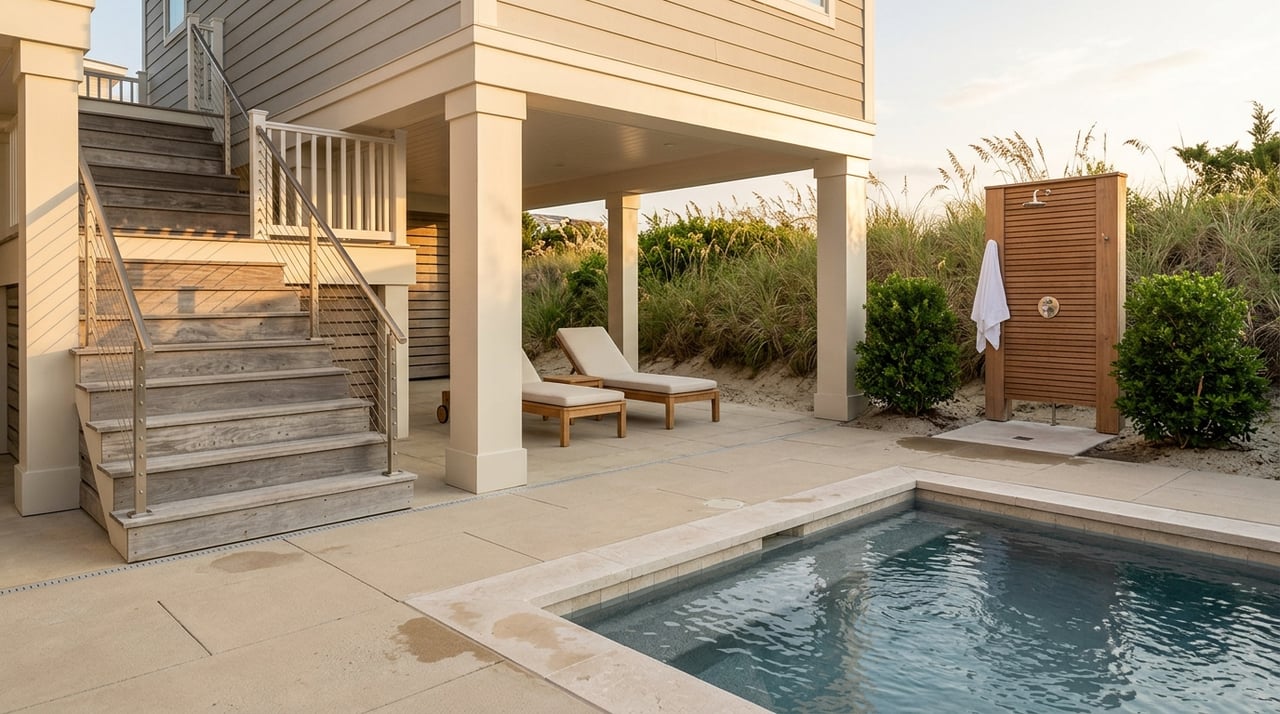
If you are watching the Duck market from afar, one question usually comes first: what actually makes a home “luxury” here? In Duck, the answer is not just price. It is about scarce waterfront locations, private-style access, resort-level amenities, and the kind of lifestyle that keeps buyers coming back to this stretch of the Outer Banks. If you are thinking about buying or selling in Duck, understanding how this market works can help you make smarter, more confident decisions. Let’s dive in.
What Luxury Means in Duck
In many markets, luxury starts with a price point. In Duck, price matters, but location and experience matter just as much. Public market data shows Duck around the $1 million level overall, yet the upper tier stands apart because buyers are often looking for oceanfront or soundfront settings, privacy, and amenity-rich homes.
A national benchmark can help frame that difference. In Redfin’s Q4 2025 luxury report, luxury homes are defined as the top 5% of a metro area’s price range, with a typical U.S. luxury sale price of $1.31 million. Duck is not a metro market, but that benchmark helps explain why a town with a roughly $1 million median still has a clearly defined luxury segment.
At the top end in Duck, buyers often expect features that support both comfort and rental appeal. Public listing records highlight amenities such as elevators, private pools, hot tubs, theater rooms, game rooms, wet bars, expansive decks, and private beach walkways. Recent public sales have also shown oceanfront homes reaching into the multi-million-dollar range, reinforcing how distinct the upper tier can be.
Why Duck Commands a Premium
Duck has a unique mix of scarcity and lifestyle appeal. It is Dare County’s northernmost town and one of the Outer Banks’ best-known resort destinations, which gives it strong name recognition with both repeat visitors and out-of-area buyers.
One of the biggest value drivers is access. According to the town’s beach access information, Duck does not own public beach access locations, does not allow parking at beach accesses, and limits access through privately owned and maintained locations for residents, renters, and their guests. The town also notes there is no public soundside beach access or public launch point for motorized watercraft. In simple terms, access is limited, and limited access tends to support premium pricing.
Duck also offers a lifestyle that feels more curated than crowded. The Duck Town Park and Soundside Boardwalk is a major draw, with an 11-acre soundfront park, nearly mile-long boardwalk, amphitheater, trails, kayak and canoe launch, transient boat piers, and community events. It also connects to the Village Commercial District, giving owners and guests a walkable link to local dining and retail.
For many buyers, that balance is the appeal. You get water-oriented living, a strong vacation atmosphere, and convenient access to the village core, all in a market where inventory is limited and premium homes are hard to replace.
Micro-Markets Matter in Duck
Luxury buyers in Duck are rarely shopping by town name alone. They are often comparing very specific communities, access points, and amenity packages. Public market pages break Duck into areas such as Ships Watch, Sanderling, Barrier Island Station, Bias Shores, Duck Landing, Oceancrest, Soundsea Village, Port Trinitie, Sea Ridge, Sea Tern, Snow Geese Dunes, Four Seasons in Duck, and Olde Duck Beach.
That matters because one home’s value may depend heavily on how it lives within its immediate setting. A buyer may prioritize oceanfront positioning, a soundfront sunset view, easier beach access, community amenities, or walkability into Duck Village. In a small coastal town, these differences can have a meaningful impact on both pricing and buyer demand.
Some communities also package luxury in a more lifestyle-focused way. For example, public listing information for Duck Landing describes amenities such as a clubhouse, fitness center, tennis courts, an indoor pool, beach access with parking, and sidewalks into the village. That kind of setup can appeal to both second-home buyers and investors who want a property that checks several boxes at once.
Current Duck Market Conditions
If you are trying to gauge timing, it helps to know that Duck is not behaving like a fast-moving mainstream market. It is better understood as a selective, higher-price coastal market with limited inventory and a narrower buyer pool.
According to Redfin’s February 2026 Duck housing snapshot, the median sale price was $1,010,000, up 20.6% year over year. Homes took 103 days to sell, only six homes sold, and the average sale-to-list ratio was 94.8%, with 16.7% selling above list price. Those numbers suggest meaningful value, but not constant urgency.
Zillow’s March 31, 2026 market snapshot shows a similar pricing picture, with an average home value of $1,016,592, 39 homes for sale, eight new listings, and a median list price of $1,058,317. That points to thin inventory rather than an oversupplied market.
At the same time, public data sources do not all match. Realtor.com’s December 2025 market page reported a lower median sale price and labeled Duck a buyer’s market. The most reliable takeaway is the directional one: Duck is a high-price, slower-turnover market where pricing strategy, property condition, and presentation matter.
How Duck Compares to National Luxury Trends
National luxury data offers helpful context. Redfin’s Q4 2025 luxury report found the typical U.S. luxury home took 64 days to go under contract. Duck’s local data shows a longer selling timeline, which suggests buyers here tend to be more selective and that premium listings may need a careful, well-supported market approach.
That is especially true because Duck often draws out-of-area interest. Redfin’s migration data shows buyers are not coming only from nearby markets. Search activity has come from places such as Washington, DC, New York, Richmond, Los Angeles, Philadelphia, Boston, and San Diego. That pattern aligns with second-home demand, relocation interest, and investment-driven shopping.
For sellers, that means your likely buyer may be comparing Duck not just to another home down the road, but to other lifestyle and investment options across multiple coastal markets. For buyers, it means the best properties often attract attention beyond the local area, even in a market that moves at a measured pace.
What Buyers Should Look At Closely
Buying luxury property in Duck means looking beyond finishes and views. You also want to understand how the property functions over time, especially in a coastal setting.
Here are some of the most important due-diligence items to review:
- Access model: Confirm how beach or sound access works for the property and community.
- Flood and erosion exposure: Review location-specific risk factors that may affect insurance, maintenance, and long-term planning.
- CAMA permitting: The town notes that CAMA permits may apply to development within 75 feet of the Currituck Sound, on oceanfront lots, or in VE flood-zone projects.
- Ownership costs: Review tax rates and any additional property-related costs tied to shoreline protection or project districts.
- Income potential: If you are buying as a second home with rental goals, look carefully at occupancy history, projections, and amenity appeal.
Taxes are also part of the ownership picture. The town’s current tax rates include a general rate of 0.1800, along with separate beach-nourishment Municipal Service District rates of 0.0798 for the project area and 0.1890 for oceanfront properties. Buyers should factor those costs into the full ownership equation.
What Sellers Need to Emphasize
In Duck’s luxury market, not every expensive home is positioned equally. Buyers want a clear reason why a particular property stands out, especially when they are making a long-distance or investment-minded purchase.
The strongest listings usually document the details that matter most, including:
- Location and orientation
- Water access and view lines
- Elevation and site characteristics
- Recent renovations and upgrades
- Amenity package
- Rental performance or projected income
That last point can be especially important in Duck. Public listing examples have highlighted projected rental income above $210,000 and even above $300,000 for certain homes. For many buyers, luxury and investment value overlap, so a home’s revenue story can be just as influential as its design story.
Presentation also matters because turnover is slower than in many other coastal markets. When buyers are taking their time, high-quality visuals, strong property descriptions, and accurate market positioning become even more important.
Long-Term Value in a Coastal Market
Buyers and sellers in Duck should also pay attention to the broader infrastructure and shoreline picture. Coastal resilience is not a side issue here. It is part of the long-term value conversation.
The town’s 2023 beach nourishment project covered nearly 1.7 miles and placed about 550,000 cubic yards of sand. In 2024, Duck also completed a living-shoreline and resiliency project that elevated NC 12, added sidewalks and bike lanes, restored marsh, and improved stormwater management to help reduce flooding.
These projects do not remove every coastal risk, but they do show ongoing local investment in shoreline and infrastructure conditions. For owners of oceanfront and near-ocean homes, that kind of long-term planning can play an important role in both usability and value.
There is also a broader tax and assessment angle to keep in mind. Dare County reported that its 2025 revaluation showed Duck’s property tax base rising by 73%, one of the largest increases in the county. That supports Duck’s position as a high-value market while reminding owners that assessments and carrying costs deserve close attention.
Is Duck’s Luxury Market Right for You?
Duck tends to be a strong fit if you value privacy, direct access to water, and a walkable village atmosphere. It can also be a compelling option if you want a home that serves both personal use and vacation-rental goals.
For buyers, the opportunity is finding a property that matches how you actually plan to use it, whether that means family getaways, seasonal income, or a longer-term lifestyle move. For sellers, the opportunity is showing why your home is one of the limited number of properties in Duck that truly offers something hard to duplicate.
If you want help evaluating a luxury purchase, pricing a waterfront home, or understanding rental and financing considerations in Duck, working with a local advisor can make the process much clearer. Jessica Evans offers a boutique, high-touch approach backed by local market insight, investor-minded guidance, and support tailored to how you plan to buy or sell on the Outer Banks.
FAQs
What makes a home part of the luxury market in Duck?
- In Duck, luxury is usually defined by a mix of premium location, water access, privacy, and amenities such as pools, elevators, large decks, and entertainment spaces, not just by price alone.
How competitive is the Duck luxury home market?
- Public data suggests Duck is a higher-price, slower-turnover market with selective buyers, limited inventory, and homes often taking longer to sell than the national luxury average.
What should buyers review before purchasing a luxury home in Duck?
- Buyers should review access, flood and erosion exposure, CAMA permitting, tax rates, and any rental income history or projections before moving forward.
Why do luxury homes in Duck often command premium prices?
- Limited access, scarce waterfront locations, walkable village amenities, and Duck’s strong resort appeal all help support premium pricing.
Can a luxury home in Duck also work as an investment property?
- Yes. Many upper-tier homes are evaluated for both lifestyle use and vacation-rental potential, and public listing examples often highlight projected rental income as a key selling point.